Two posts in one weekend, I must be going mad...
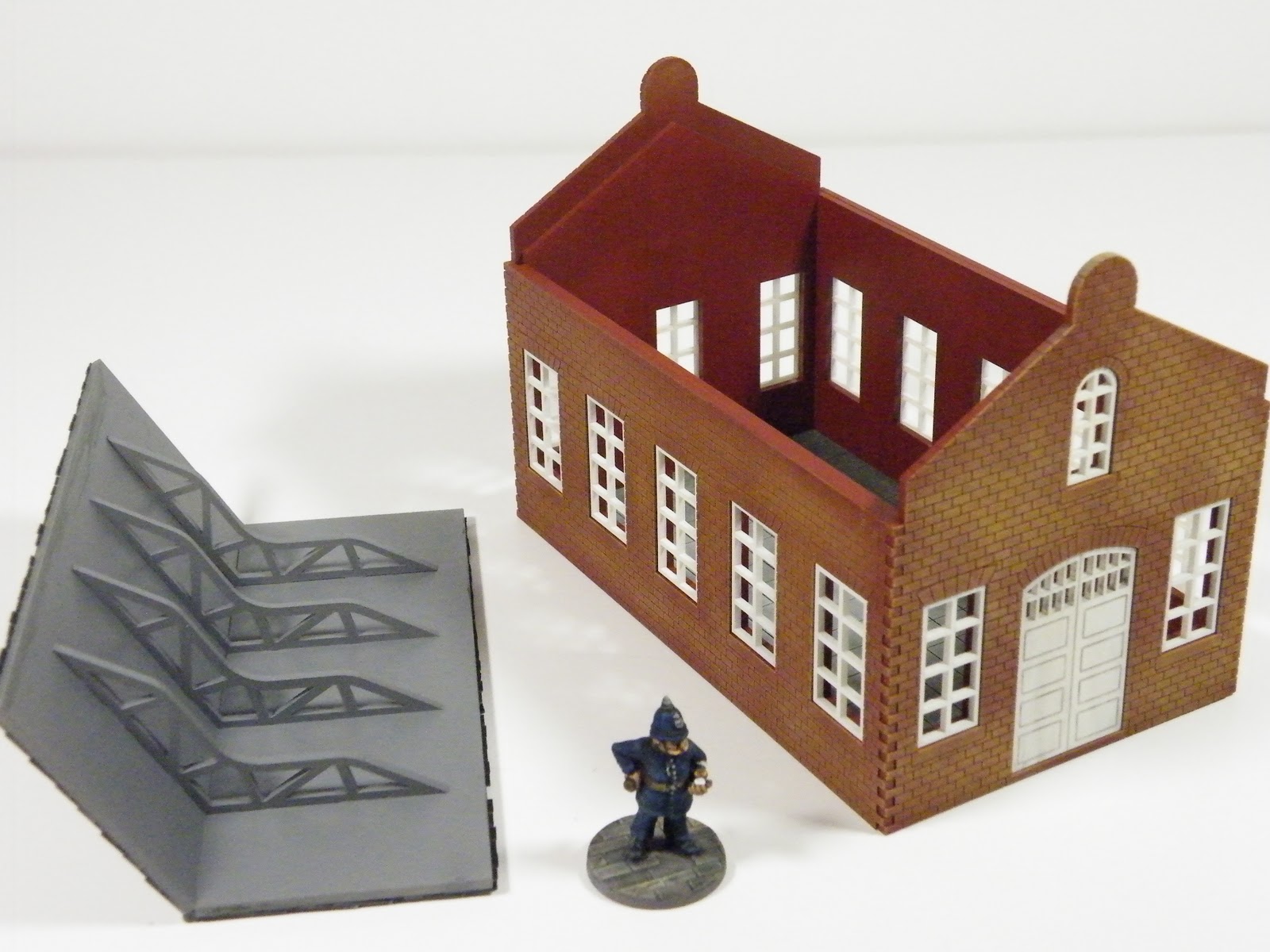
I've been working this out for a few weeks now and here is the result, a modular Victorian warehouse kit that's all ready to go (unassembled of course). As you can see form the picture to the right all the bits are there and come ready primed.
Included in the kit are the parts as follows. Front, back and side walls, roof plates and struts (including guide lines for the placement of tiles), a floor plate that sits inside the walls, door and windows (spare windows) and a sheet of tiles (enough for one roof).
The walls are designed so that they will join 'seemlessly' together and the window/door recesses have a slight ledge all the way round to support the said windows/door.
It is possible to make a larger version using two kits and I will post a little post on that in the near future.
The brick and door detail is recessed so there will be no lack of detail once it's painted. I do recommend using a spray basecoat and then normal drybrushing on top to get the desired effect.
The photo to the right shows the scored detailing a bit closer so you get an idea.
I have plans for different types of windows and doors in the near future that can be bought as a separate bundle and there will be other expansions also.
I will also be making lots of other types of building to go with this one and most of them will be able to be made together in some way (wall swaps, extensions etc).
The painted version I did quickly last night just to show the detail in a better light. Obviously this one is typical brick red but have a look in Google images for 'Victorian brick colours' to get an idea of the tones and hues available.
I will eventually be doing one in 'London stock' which is the yellowy/cream colour found in London and the surrounding area. Of course the roof can be left removable so as to have interior access and the door/windows can be left loose (or blu-tacked in place) to allow for the simulation of damage etc.
This is available now but won't be on the website for a while yet so if you fancy one then just e-mail me :-)
Well, that's all for now, I have a gaming weekend of games, food, beer and madness to get ready for next week :-D
ttfn
This where all my hobby and OSHIRO items will be posted. It's an eclectic mix but hopefully there's a bit of something for most people (if not everyone :-).
30/10/2011
28/10/2011
28mm Yamashiro is ready
The modular yamashiro is finally ready to sell and it will be going on the website next week.
First off is the gateway, nice and simple as mentioned in a post below. This section is 150mm long like the straight sections already available and is about 100mm high. The gap under the gatehouse is approx 45mm.
The next two sections are both 60 degree corners, one internal and one external. I have started on the masters for 30 degree corners but these won't be ready for a while yet.
One of the options that will be on the website proper is a set of one gateway, two external corners and two straight sections. There will also be an expansion of more straights and internal corners but that yet to be finalised.
The set option is shown on the left and although it won't fit flush with a table edge I don't think this will be a problem.
The buildings in the yamashiro section will also be available in a set and there are more waiting in the wings to be finished off.
I also have plans for a few other sections which I think I mentioned in a previous post but I'll mention them again.
There will be a integrated wall building (used either as a store room or barracks), a corner tower but the size is no where near decided yet. There will also be a small tenshu or keep and a slightly larger barrack building.
I'm also thinking of an openwork watchtower but that's a fair way off yet.
ttfn
First off is the gateway, nice and simple as mentioned in a post below. This section is 150mm long like the straight sections already available and is about 100mm high. The gap under the gatehouse is approx 45mm.
The next two sections are both 60 degree corners, one internal and one external. I have started on the masters for 30 degree corners but these won't be ready for a while yet.
One of the options that will be on the website proper is a set of one gateway, two external corners and two straight sections. There will also be an expansion of more straights and internal corners but that yet to be finalised.
The set option is shown on the left and although it won't fit flush with a table edge I don't think this will be a problem.
The buildings in the yamashiro section will also be available in a set and there are more waiting in the wings to be finished off.
I also have plans for a few other sections which I think I mentioned in a previous post but I'll mention them again.
There will be a integrated wall building (used either as a store room or barracks), a corner tower but the size is no where near decided yet. There will also be a small tenshu or keep and a slightly larger barrack building.
I'm also thinking of an openwork watchtower but that's a fair way off yet.
ttfn
15/10/2011
More ashigaru for Caesar?!?
Just a small post today of my second Hail Caesar samurai forces.
These boys are Sanada clan and there are five bases for my typical unit frontage but not all of them have four figures on. The figures lend themselves to have a bit of disorganisation and so several of the bases only have three figures on them.
I'm thinking I might employ this more often as it would save a little bit on figures and give them a more 'authentic' look.
The banner was hand painted again along with the mon on the jingasa. I left the sashimono blank as this seemed to be the case for quite a few ashigaru units (well, according to a couple of Japanese books I've got).I will, at some point, set up a decent photography area in my room as my camera skills leave a lot to be desired :-/ However, in the mean time, these will have to do.
I've got the next unit primed and mounted for painted but I probably won't touch them for a while as I've got a few commissions to get cracking on with.
ttfn
These boys are Sanada clan and there are five bases for my typical unit frontage but not all of them have four figures on. The figures lend themselves to have a bit of disorganisation and so several of the bases only have three figures on them.
I'm thinking I might employ this more often as it would save a little bit on figures and give them a more 'authentic' look.
The banner was hand painted again along with the mon on the jingasa. I left the sashimono blank as this seemed to be the case for quite a few ashigaru units (well, according to a couple of Japanese books I've got).I will, at some point, set up a decent photography area in my room as my camera skills leave a lot to be desired :-/ However, in the mean time, these will have to do.
I've got the next unit primed and mounted for painted but I probably won't touch them for a while as I've got a few commissions to get cracking on with.
ttfn
09/10/2011
Hail Caesar samurai.
Well, samurai and ashigaru.
I've finally finished my first proper unit for Hail Caesar (as opposed to re-basing existing figures).
The clan is Myoshi which, along with Sanada, are going to be my main clans for the time being. There are so many that it does become difficult to pick between them.
There are five bases in total and I think that will be the norm for nagai-yari ashigaru (pikes). For the teppo and yumi (arquebus and bow) armed troops I'll be doing four bases with a smaller amount of command.
I still have the nobori to do (two off) and I'm torn between hand painting or printing and touching up.
I'm also working on a divisional command base for my Sanada (already got one for the Myoshi, see an earlier post).
I have enough troops for a small division (two pike and one arquebus) and when I get them back I'll be re-basing them all and then, then I'll be able to have a game. Still got to sort out the tweaks for the rules which I'll get round to over the next few weeks or so.
Below are some pictures of existing figures that I'll leave you with to enjoy :-)
ttfn
I've finally finished my first proper unit for Hail Caesar (as opposed to re-basing existing figures).
The clan is Myoshi which, along with Sanada, are going to be my main clans for the time being. There are so many that it does become difficult to pick between them.
There are five bases in total and I think that will be the norm for nagai-yari ashigaru (pikes). For the teppo and yumi (arquebus and bow) armed troops I'll be doing four bases with a smaller amount of command.
I still have the nobori to do (two off) and I'm torn between hand painting or printing and touching up.
I'm also working on a divisional command base for my Sanada (already got one for the Myoshi, see an earlier post).
I have enough troops for a small division (two pike and one arquebus) and when I get them back I'll be re-basing them all and then, then I'll be able to have a game. Still got to sort out the tweaks for the rules which I'll get round to over the next few weeks or so.
Below are some pictures of existing figures that I'll leave you with to enjoy :-)
ttfn
25/09/2011
Paddy fields
It's been a while but I haven't been slacking, I've been a bust little bee and tonight there's something to show :-)
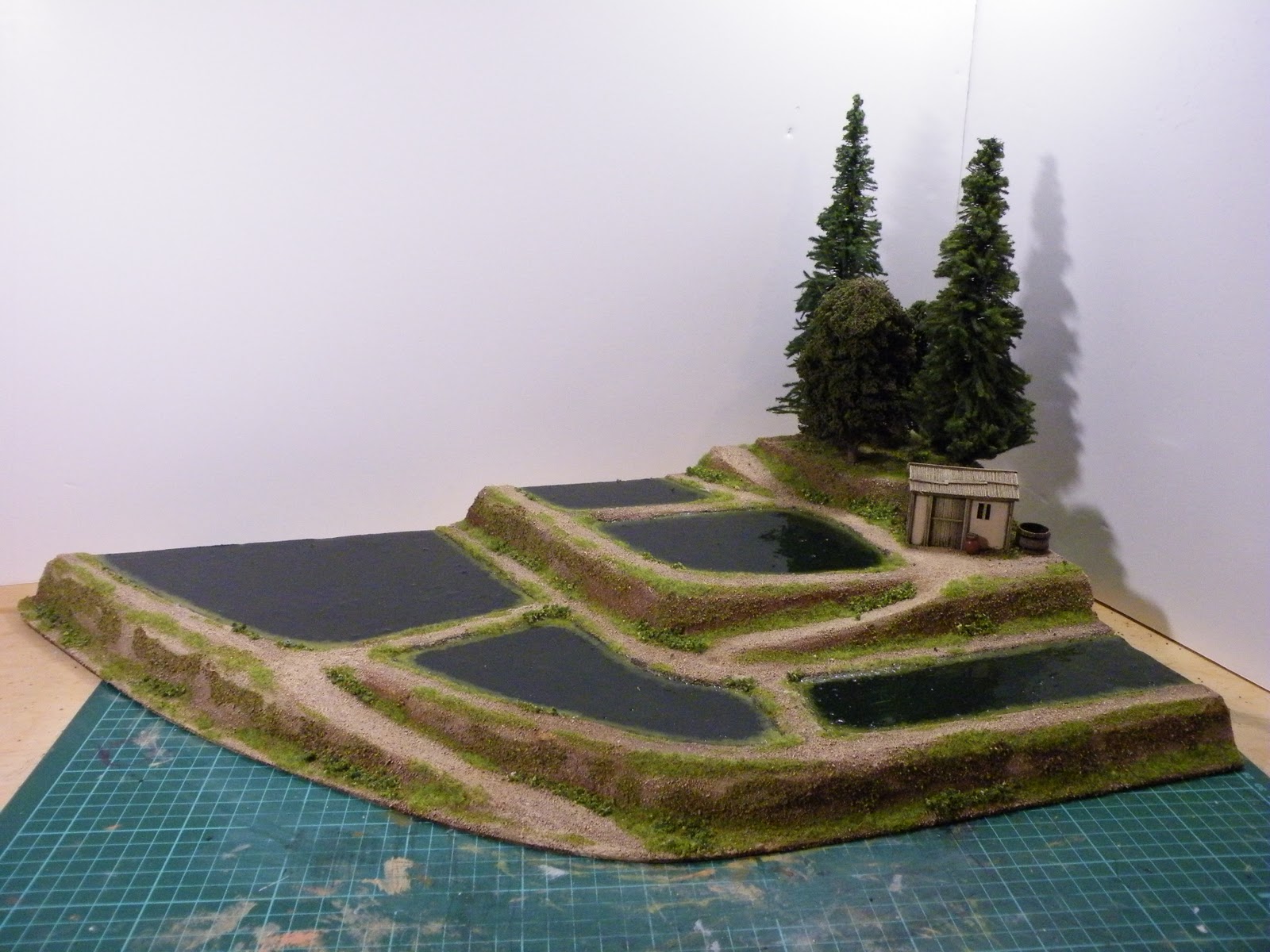
Having been to Japan several times and seeing the layout of the general landscape (countryside that is, not the urban areas), I've noticed that paddy fields (or tambo) are quite often found on the sides of foothills sloping up to the hills proper so I thought I would make one for the table top.
Quite simple construction really, hardboard base with 25mm insulation foam layers. You've heard it called 'blue' or 'pink' foam but this stuff is actually a strange mustard colour :-/
The foam was roughly cut to shape (three layers, each smaller than the one below) and stuck together. The paths were then cut in because I wanted to get them in the right place to get the 'feel' of the location right and it was easier to do this with all the layers stuck together.
The field borders were made from 2mm thick card cut with a bevelled edge and filled smooth with normal household filler. The whole lot was given a quick sand down to get rid of the worst lumps and then everything apart from the fields themselves were sanded as normal.
I unfortunately didn't take any photos of the intervening stages but it's the same sort of process that I implement on most of the other terrain I make.
The fields themselves were painted with a very dark green and highlighted around the edges and corners. They were then given a coat of yacht varnish and will be given more when the first coat has gone off. The more coats you can put on the better as it really adds to the depth of the water.
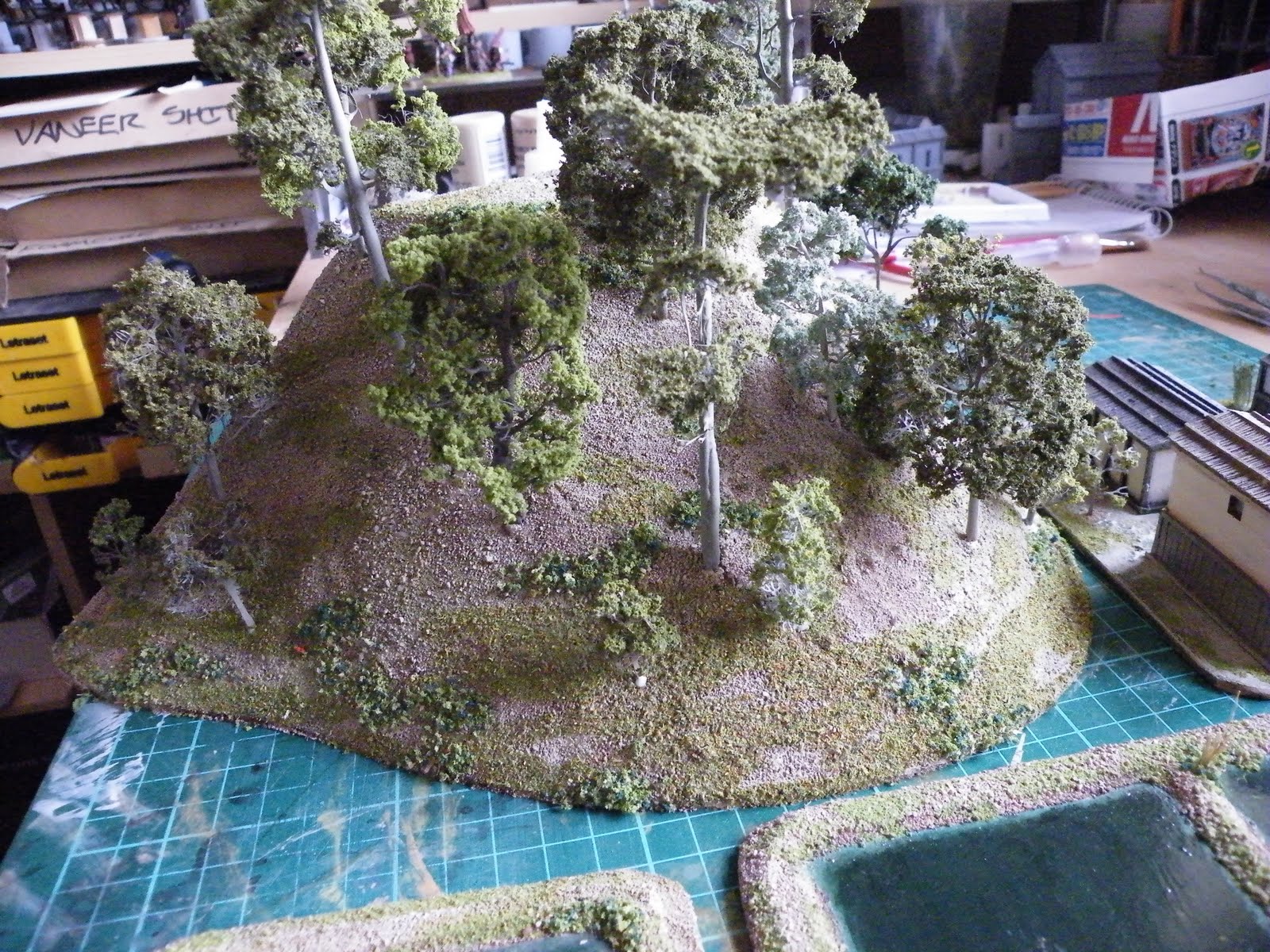
At some point in the near future I shall get my boards out and do a sort of photoshoot but enough yammering form me, more photos below :-)
ttfn
Having been to Japan several times and seeing the layout of the general landscape (countryside that is, not the urban areas), I've noticed that paddy fields (or tambo) are quite often found on the sides of foothills sloping up to the hills proper so I thought I would make one for the table top.
Quite simple construction really, hardboard base with 25mm insulation foam layers. You've heard it called 'blue' or 'pink' foam but this stuff is actually a strange mustard colour :-/
The foam was roughly cut to shape (three layers, each smaller than the one below) and stuck together. The paths were then cut in because I wanted to get them in the right place to get the 'feel' of the location right and it was easier to do this with all the layers stuck together.
The field borders were made from 2mm thick card cut with a bevelled edge and filled smooth with normal household filler. The whole lot was given a quick sand down to get rid of the worst lumps and then everything apart from the fields themselves were sanded as normal.
I unfortunately didn't take any photos of the intervening stages but it's the same sort of process that I implement on most of the other terrain I make.
The fields themselves were painted with a very dark green and highlighted around the edges and corners. They were then given a coat of yacht varnish and will be given more when the first coat has gone off. The more coats you can put on the better as it really adds to the depth of the water.
At some point in the near future I shall get my boards out and do a sort of photoshoot but enough yammering form me, more photos below :-)
ttfn
28/08/2011
28mm Samurai terrain (roadside shrine)
Aha, two posts today? Hell yeah!
Well, I've been off all week with nasty germs and so have had a bit of time (not much though as my wife has been keeping tabs on me) to make things :-)
For the samurai I thought it was about time to make something a bit more than stand alone and so the thought of a roadside shrine to into being.
I wanted to use items that are available from the catalogue just to show what could be possible with a little bit of imagination.
Having come across something similar in Japan it was quite easy to decide the layout which you can see on the right. The figure is an unbased Perry cavalry samurai..
I decided to make the torii from scratch (which they all are) because the ones in the catalogue are already based and I wanted this one integral to the base. Most of these rural shrines have a gravel path leading up to them but I wanted this one to have a disheveled look so some of the border stones are slightly out of place.
This shot shows the final layout and it has also been sanded (sieved builders sand) and covered in thin brown ink. the roof for the moment is separate but everything else is stuck down (a slight mistake on my part but not too troublesome).
Here we have a shot of the basic greenery on the base. I decided to go for three different types of 'growie' for maximum effect and a slightly overgrown appearance.
All the parts were painted in the same way as the catalogue items, I didn't think much point in painting them differently.
The path was drybrushed with various greys and the earth with beiges and tans, building up a nice varied tone throughout.
The growies were added with thinned down white wood glue that was randomly brushed on, the growies being scattered on at three different times, letting each one dry before putting the next one on.
There are a few places where the growies have grown onto the path (hopefully you can see them) and I've also put a few tall grass clumps on just to add to the variation. The trees are old ones from work.
I did think of using some Silfor but it seems everyone is doing it now and I wanted something slightly different. Below we have the beauty shots and there are quite a few because I'm quite pleased with this one :-) I have a few other things of this nature planned but time will tell...
Well, I've been off all week with nasty germs and so have had a bit of time (not much though as my wife has been keeping tabs on me) to make things :-)
For the samurai I thought it was about time to make something a bit more than stand alone and so the thought of a roadside shrine to into being.
I wanted to use items that are available from the catalogue just to show what could be possible with a little bit of imagination.
Having come across something similar in Japan it was quite easy to decide the layout which you can see on the right. The figure is an unbased Perry cavalry samurai..
I decided to make the torii from scratch (which they all are) because the ones in the catalogue are already based and I wanted this one integral to the base. Most of these rural shrines have a gravel path leading up to them but I wanted this one to have a disheveled look so some of the border stones are slightly out of place.
This shot shows the final layout and it has also been sanded (sieved builders sand) and covered in thin brown ink. the roof for the moment is separate but everything else is stuck down (a slight mistake on my part but not too troublesome).
Here we have a shot of the basic greenery on the base. I decided to go for three different types of 'growie' for maximum effect and a slightly overgrown appearance.
All the parts were painted in the same way as the catalogue items, I didn't think much point in painting them differently.
The path was drybrushed with various greys and the earth with beiges and tans, building up a nice varied tone throughout.
The growies were added with thinned down white wood glue that was randomly brushed on, the growies being scattered on at three different times, letting each one dry before putting the next one on.
There are a few places where the growies have grown onto the path (hopefully you can see them) and I've also put a few tall grass clumps on just to add to the variation. The trees are old ones from work.
I did think of using some Silfor but it seems everyone is doing it now and I wanted something slightly different. Below we have the beauty shots and there are quite a few because I'm quite pleased with this one :-) I have a few other things of this nature planned but time will tell...
ttfn
13/08/2011
A small generic tug boat
Ah crap, it's been to long. And here I was saying that I would get at least a couple of posts a week down...
Anyway, for tonight's viewing pleasure I have a 28mm Victorian tug boat that I've been meaning to do for a while now. If any of you chaps reading this frequent the Lead Adventure Forum (and if you don't I heartily suggest you do!) you will know that I am doing a Victorian sci-fi force of a Japanese colony on Mars. Many troops and flying things have already been done and will get put up here at some point but I have plenty of civvy things in mind to go with the force and this is one of them.
Basic construction is a blue-foam hull with card and balsa wood decking with a card wheel house and plastic tube for the funnel.
The hull sides are from card and took a while as I had to bend the card (1.5mm thick) and tape it for a couple of days to let the wood glue go off completely. It's not the best way to do it but I was feeling a bit lazy and wanted to get it done. The card was cut off roughly at the bottom following the blue foam and then I took it into work and took a bit more off the bottom with the bandsaw (it was too high as it was). The edging is microstip.
The rear 'hatch' and stowage box are from sheet styrene and perspex with relevant details from microstrip added (hinges etc.).
The figure is an unknown bobby which is actually a rather nice sculpt and was pleasing to paint.
Other little details were added such as the small sand bucket and the ladders to get to the fore deck. Rivets were glued onto the doors, roof and 'boiler' block to add a bit more of a something. I wanted to keep it simple because I know I can get bogged down in detail and not finish what I started. Fortunately, I think there is enough here to look pleasing and to be playable also.
The shot to the left is of the tug with a coat of Halfords grey primer (one of the best all round primers out there I reckon). If you click on the picture itself you can make out the details better. The canvas roll on the side of the boiler block is from Games Workshops Imperial Guard range from one of the tank kits and have proved useful in the past for various projects.
Next was deciding on the colour scheme, something simple was called for but recognizable as a generic tug. In this Google images was my friend and the next shot shows the basic colour design I went for.
The white strip was painted first and then it was masked out with normal masking tape and a scalpel blade was stuck flat to a block to create a constant level to cut the masking tape around the shape of the hull. When doing this a few light strokes are much better than one heavy one because even tough the blade is stuck down (with superglue) it can still drift off line if you're not careful. The lower portion of the tape was removed and a deep red was painted on the bottom of the hull. When this was dry the process was repeated slightly higher up to create the upper edge of the white band, black was painted above this line and when this was dry the masking was removed to reveal an even white line all the way round the hull.
There were some slight mistakes but I left them on as the tug is a work horse and I didn't think the owner would be too bothered by a sloppy paint job ;-)
The deck was painted with Foundry Palomino light and then given several different brown washes to give some depth to the deck. The wheel house was coated with Foundry Granite and washed with a mix of Devlan mud and Thraka green inks again from GW (some really stupid names for their paints :-/ ). It was then dry-brushed with a light grey I had. The stowage box was painted with a light grey, washed with the above and the touched up with normal white paint.
For the rust I mixed a very watery but bright orange ink and used a fine brush to localise where the rust might form. The main hull was dry-brushed with the same light tan colour used for the deck as I wanted to tie the whole thing together and the windows were given a coat of very dark blue with no high lighting because I don't think it works to well. the funnel was given a band of white but I decided to leave the funnel the same colour as the wheel house instead of doing it in more traditional tug colours (tan, red and black) as it will match my Japanese aeroneff force. The chap on the front is a converted Copplestone Chinese general.
The final shot is of the rear and it shows the details off quite well.
I went around most of the edges with a very dark brown ink just to help emphasize the shading. The rigging (two pictures above) was simply black thread with a touch of thin superglue to hold it in place and as soon as I can get my dratted printer to work again I will print out a Japanese navel ensign just so we know who's it is :-).
If anyone has any questions (because I've been quite brief) then please leave a comment and I'll get back to you. Thanks for reading (if you managed to get through it all). there will be another small post tomorrow about my Hail Caesar samurai and samurai terrain.
ttfn
Anyway, for tonight's viewing pleasure I have a 28mm Victorian tug boat that I've been meaning to do for a while now. If any of you chaps reading this frequent the Lead Adventure Forum (and if you don't I heartily suggest you do!) you will know that I am doing a Victorian sci-fi force of a Japanese colony on Mars. Many troops and flying things have already been done and will get put up here at some point but I have plenty of civvy things in mind to go with the force and this is one of them.
Basic construction is a blue-foam hull with card and balsa wood decking with a card wheel house and plastic tube for the funnel.
The hull sides are from card and took a while as I had to bend the card (1.5mm thick) and tape it for a couple of days to let the wood glue go off completely. It's not the best way to do it but I was feeling a bit lazy and wanted to get it done. The card was cut off roughly at the bottom following the blue foam and then I took it into work and took a bit more off the bottom with the bandsaw (it was too high as it was). The edging is microstip.
The rear 'hatch' and stowage box are from sheet styrene and perspex with relevant details from microstrip added (hinges etc.).
The figure is an unknown bobby which is actually a rather nice sculpt and was pleasing to paint.
Other little details were added such as the small sand bucket and the ladders to get to the fore deck. Rivets were glued onto the doors, roof and 'boiler' block to add a bit more of a something. I wanted to keep it simple because I know I can get bogged down in detail and not finish what I started. Fortunately, I think there is enough here to look pleasing and to be playable also.
The shot to the left is of the tug with a coat of Halfords grey primer (one of the best all round primers out there I reckon). If you click on the picture itself you can make out the details better. The canvas roll on the side of the boiler block is from Games Workshops Imperial Guard range from one of the tank kits and have proved useful in the past for various projects.
Next was deciding on the colour scheme, something simple was called for but recognizable as a generic tug. In this Google images was my friend and the next shot shows the basic colour design I went for.
The white strip was painted first and then it was masked out with normal masking tape and a scalpel blade was stuck flat to a block to create a constant level to cut the masking tape around the shape of the hull. When doing this a few light strokes are much better than one heavy one because even tough the blade is stuck down (with superglue) it can still drift off line if you're not careful. The lower portion of the tape was removed and a deep red was painted on the bottom of the hull. When this was dry the process was repeated slightly higher up to create the upper edge of the white band, black was painted above this line and when this was dry the masking was removed to reveal an even white line all the way round the hull.
There were some slight mistakes but I left them on as the tug is a work horse and I didn't think the owner would be too bothered by a sloppy paint job ;-)
The deck was painted with Foundry Palomino light and then given several different brown washes to give some depth to the deck. The wheel house was coated with Foundry Granite and washed with a mix of Devlan mud and Thraka green inks again from GW (some really stupid names for their paints :-/ ). It was then dry-brushed with a light grey I had. The stowage box was painted with a light grey, washed with the above and the touched up with normal white paint.
For the rust I mixed a very watery but bright orange ink and used a fine brush to localise where the rust might form. The main hull was dry-brushed with the same light tan colour used for the deck as I wanted to tie the whole thing together and the windows were given a coat of very dark blue with no high lighting because I don't think it works to well. the funnel was given a band of white but I decided to leave the funnel the same colour as the wheel house instead of doing it in more traditional tug colours (tan, red and black) as it will match my Japanese aeroneff force. The chap on the front is a converted Copplestone Chinese general.
The final shot is of the rear and it shows the details off quite well.
I went around most of the edges with a very dark brown ink just to help emphasize the shading. The rigging (two pictures above) was simply black thread with a touch of thin superglue to hold it in place and as soon as I can get my dratted printer to work again I will print out a Japanese navel ensign just so we know who's it is :-).
If anyone has any questions (because I've been quite brief) then please leave a comment and I'll get back to you. Thanks for reading (if you managed to get through it all). there will be another small post tomorrow about my Hail Caesar samurai and samurai terrain.
ttfn
17/07/2011
More yamashiro
Just a short post to show the gateway for the yamashiro that I'm working on at the moment. It's based on several of the many yamashiro that have 'appeared' in Japan in recent times (Think how motte and baily castles are studied in England as an example of what I mean).
This gateway is quite a simple one which will make it quite easy to cast. It will come fully assembled with the gates under the block house hopefully positionable and either painted or unpainted like all the rest of the catalogue items.
I've still got a wall with an integral building to make amongst other but this is ready to go in the mould this week along with the angled walls and with luck it should be on the website by next week
Of course, there are many different styles of gateway, wall, tower etc but like anything, it's getting the best choice and balance for the wargaming table.
Anyway, enough from me, I have things to make and cycling to watch :-)
ttfn
This gateway is quite a simple one which will make it quite easy to cast. It will come fully assembled with the gates under the block house hopefully positionable and either painted or unpainted like all the rest of the catalogue items.
I've still got a wall with an integral building to make amongst other but this is ready to go in the mould this week along with the angled walls and with luck it should be on the website by next week
Of course, there are many different styles of gateway, wall, tower etc but like anything, it's getting the best choice and balance for the wargaming table.
Anyway, enough from me, I have things to make and cycling to watch :-)
ttfn
I have my mojo back !
Well, after a cracking holiday, rather bad e-mail problems and a short time being a couch potato I'm back making things and rather enjoying it as well :-)
First off, I've been busy all weekend making more of the large 15mm samurai terrain commission, a selection of which can be seen on the right here.
Before it goes to the client I think I'll do a proper set up on my boards and get some really good photos done as it all looks quite good at the moment as it is (even though I do say so myself ;-)
There is quite a wide selection of items that were ordered and it's been fun doing them all actually. Whereas my preference is for 28mm, doing these has given me a chance of doing 'more' to fit on the table as it were. I'm not going to drastically change to 15mm but I think I'll get a few more painted and see what small scale rules are out there (skirmish most probably).
Having made a steep Japanese style mountain before in 28mm it wasn't to hard to make a 15mm one, just cutting down the growie detail a little bit and obviously the scale of the trees.
It has a base and rear face of MDF as it will be placed on the table edge.
The flat area on top is for a small temple which is almost ready for casting. It's basically the same as the odou from the 28mm catalogue .
The trees are removable but some of the small bushes have been permanently glued in to break up the large surface area of the mountain side. There is another one to do which will sit in the corner of the table, more on that in a later post.
There are also some river sections that have been done and more to do. It's been quite difficult to get a river colour that I'm happy with but I think with a bit more work this one seems to fit the bill.
The sections need another couple of coats of varnish on them and some slight variations in tone to the water and then they'll be done.
There are also a bridge and water mill sections to be made and these will get posted when they are complete. I'm half tempted to paint the bridge red but that's not really accurate for the countryside ;-)
Next up is a stepped to go in the middle of the table, not too happy with the height of the steps but we'll see what happens.
All the terrain has the same groundwork on them and I'm quite pleased with the result, it's not to flat in colour but not overly colourful (if that makes sense).
I think I'll make some of these for myself but perhaps slope the edges a bit more to make their impact on the table a little less imposing.
Well that's enough chatter from me, I'll put up some more pictures below for your pleasure :-)
ttfn
First off, I've been busy all weekend making more of the large 15mm samurai terrain commission, a selection of which can be seen on the right here.
Before it goes to the client I think I'll do a proper set up on my boards and get some really good photos done as it all looks quite good at the moment as it is (even though I do say so myself ;-)
There is quite a wide selection of items that were ordered and it's been fun doing them all actually. Whereas my preference is for 28mm, doing these has given me a chance of doing 'more' to fit on the table as it were. I'm not going to drastically change to 15mm but I think I'll get a few more painted and see what small scale rules are out there (skirmish most probably).
Having made a steep Japanese style mountain before in 28mm it wasn't to hard to make a 15mm one, just cutting down the growie detail a little bit and obviously the scale of the trees.
It has a base and rear face of MDF as it will be placed on the table edge.
The flat area on top is for a small temple which is almost ready for casting. It's basically the same as the odou from the 28mm catalogue .
The trees are removable but some of the small bushes have been permanently glued in to break up the large surface area of the mountain side. There is another one to do which will sit in the corner of the table, more on that in a later post.
There are also some river sections that have been done and more to do. It's been quite difficult to get a river colour that I'm happy with but I think with a bit more work this one seems to fit the bill.
The sections need another couple of coats of varnish on them and some slight variations in tone to the water and then they'll be done.
There are also a bridge and water mill sections to be made and these will get posted when they are complete. I'm half tempted to paint the bridge red but that's not really accurate for the countryside ;-)
Next up is a stepped to go in the middle of the table, not too happy with the height of the steps but we'll see what happens.
All the terrain has the same groundwork on them and I'm quite pleased with the result, it's not to flat in colour but not overly colourful (if that makes sense).
I think I'll make some of these for myself but perhaps slope the edges a bit more to make their impact on the table a little less imposing.
Well that's enough chatter from me, I'll put up some more pictures below for your pleasure :-)
ttfn
Subscribe to:
Comments (Atom)