20/02/2012

SALUTE 2012 progress

Had a great weekend just gone working on the samurai Salute board and for today I'll show you one of the complete 2x2 boards.

The basic layout is shown to the right, about half the board is river with a typical Japanese bridge crossing it and the other half is a more common area of the town.

The parallel lines are the gutters, more on which later. The main construction is of 12mm MDF (generic wood, resin and glue composite) which, although heavy, gives a sturdy platform on which to build and paint.

The MDF doesn't go all the way under the raised bit, just a little to provide the top portion a bit of support. The top is also 12mm with the gutters cut out on the table saw.

The bridge is the main feature on this 2x2 board so a bit of time was spent on it. Finding reference was easy, I didn't even have to look in my reference folder, a quick google image search was all that was needed.

To build something like this the most important thing is to jig it up right at the start.

A 'jig' is a framework, support or construction that aids the building of another piece, usually they are sacrificial but get them right and it makes the whole job easier. Time spent making a decent jig, no matter how small the actual piece will save you a lot of frustration!

As Japanese bridges are on the whole arched each set of legs (five in total) had to have a seperate jig, all that was needed though was to slightly alter the height of the drawing and then cut out the parts on the laser, assemble them and place the balsa parts.

The cross members are from lasered perspex as it will lend strength and you won't see then that much. Once each set of legs is made they are attached to the main 'sleepers' by way of another jig (which I forgot to take a picture of) and then the top planks are glued on. I might go for a hand rail at the sides but as I want to get the main stuff out of the way first this will be a last minute option.

The 'banking' is made from a yellow insulation foam (the same type used in the corner paddy fields). This has been pounded with a suitable rock and then the stonework marked on with a sharp pen.

The ground work was done in the normal way of fine sand, inked over with brown ink and then brought up with several drybrushes of lightening tans. A small channel was cut out of the banking (which was painted light grey, shaded and weathered after) for the gutter water to run out of into the river.

Small 'bridges' were made over the gutters out of thin balsa to give the appearance of allowing the town dwellers access to their houses/shops. The river was also painted at this stage with varying greens and given several coats of yacht varnish.

The shot to the left shows a bit of closer detail of the small bridges and the bank. Some yacht varnish was also applied to the bottoms of the gutters just to add that little bit extra. The bridge was then painted brown with a lot of drybrushing to bring out the wood texture. small amounts of growies and grasses were added in various places to enhance the general look of the area.

As ever, I'll leave you with some more shots of the complete board. A better discription on the whole project will be in the next post in the coming week or so.


ttfn

09/02/2012

Japanese village base

I was hoping to get this done last month but as always 'real' life gets in the way (house hunting for one) and so it's in February's offerings.

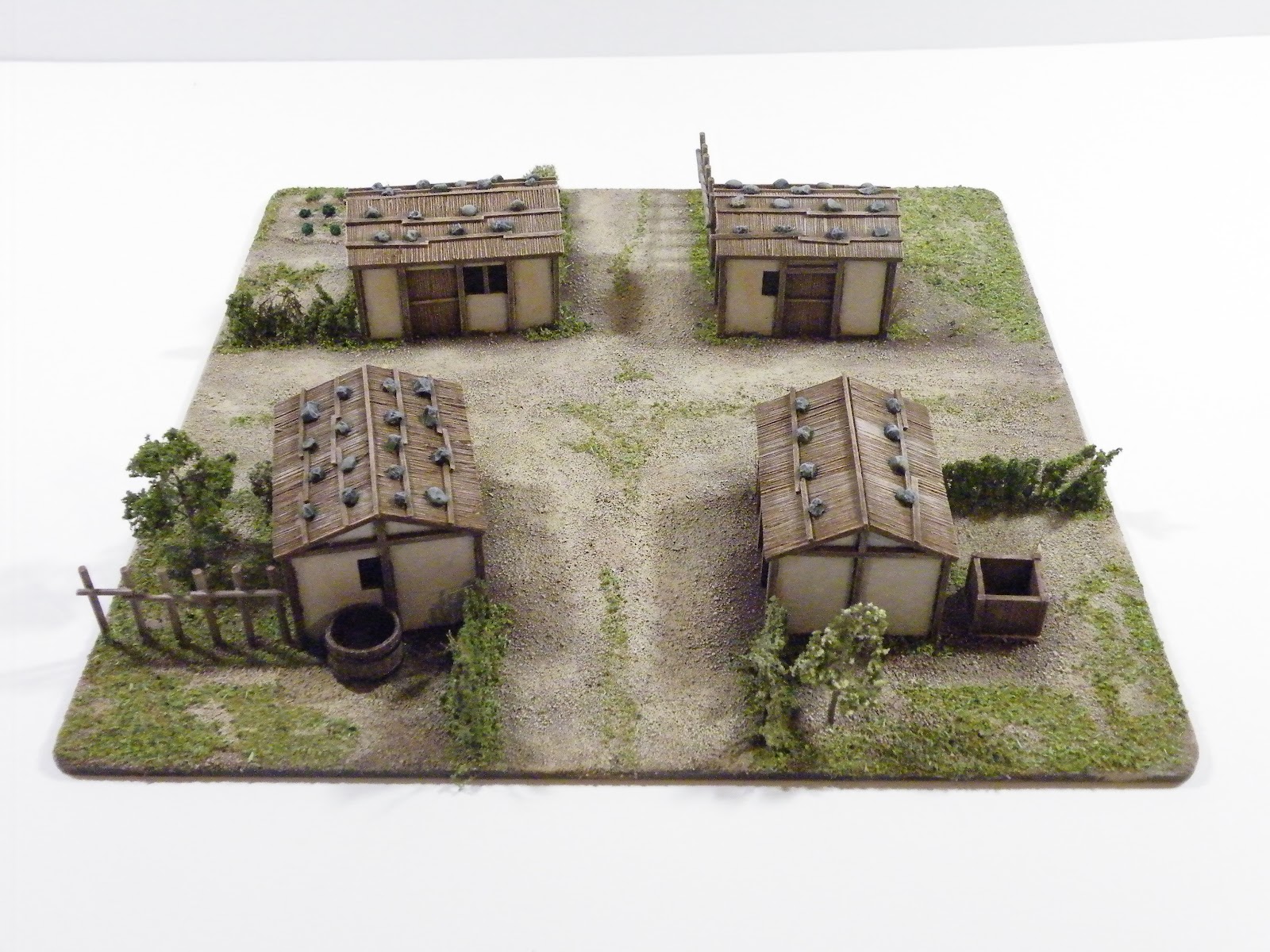
The brief was quite simple, a village base of three to four buildings on a foot square base with enough room for an Impetus base and a cherry tree :-)

I was originally going for a simple cross road layout but after a bit of though I changed it slightly to a tee junction with a smaller 'lane' leading off the top of the tee (as can be seen in later photos).

It was made in pretty much the same way as I do most of my Japanese terrain but the buildings were given a more rural feel with the addition of stones on the roof. These were used to keep the roof shingles in place and also Japan can get quite windy sometimes ;-)

As you can see from the photo on the left, the two rear buildings have been moved closer together. This helps give the base a more rural and random feel instead of the regimented layout in the photo at the top. The buildings were dirtied down somewhat as well.

The base was sanded and painted as normal and various types of 'growies' were added in varying places to give a natural feel to the layout.

A couple of rough fences and hedges were added also. The hedges are supposed to represent bamboo hedges of the type that were grown over there. The bamboo would be tightly grown and bound to form the length and breadth of the hedge and they would be trimmed periodically to keep the height down. It seems to have worked on the model but I'm always looking out for something that would be better.

A cherry tree was added and a few bits from the additions range. I also made a small field in the back of one of the buildings and a well in another.

It should fit well with the rest of the terrain that I have made for this group (nice bunch of chaps in sunny Scotland) and hopefully there should be some more in the offing which will be nice. I believe they are putting on a demo game at Carronade on the first of May, so if you are in the area drop by a have a shufty ;-) I'll leave you with some more beauty shots.

ttfn


15/01/2012

15mm Samurai terrain

Well, three posts in one week! Something must be going on... Anyway, for todays little sojourn we have a few 15mm town/village bases.

Basically they are buildings from the catalogue stuck onto generic base sizes and then given groundwork treatment around them. I haven't put as much detail as I would for a 28mm version as it would just get in the way for gaming and be quite delicate.

There is enough there though to make it look convincing though.

One thing that wasn't originally intended was the field base (shown left, not the best picture) but I thought it should be done as pretty much every single town, village etc would have fields (both paddy and normal) surrounding them.

One feature of a Japanese field is the raised beds, there are quite a few reasons for this which I won't go into now (a post all by itself!) but it certainly gives a definite feel for a gaming piece.

Also, orchards are grown over there with various fruit trees.

Not much else to say really apart from the fact that I quite enjoyed making it (as I do with all the projects I get) but I got more a sense of satisfaction for this one.

I'd like to get into 15mm gaming a bit more to allow for this sort of thing to be on the table without taking up the whole thing :-)

As ever, I'll leave you with some different shots.

ttfn


14/01/2012

Chinese fireworks factory

For todays diversion we have a Chinese fireworks factory that was commissioned by a very nice chap from the LAF.

The brief was quite basic, just a compound with a couple of buildings and a broken wall with firework stand as fill-ins and a damaged section as if the fireworks had gone off prematurely. I got the inspiration for the layout from an old Boxer rebellion photo and the rest just sort of fell into place. The basic construction was out of 5mm perspex with various windows and doors laser cut out.


The layout changed somewhat from the initial design but the client was fine with this and once the basic construction was finished the details were added.

As it is supposed to be a factory I thought they would probably test the fireworks on site so I made a small 'launch' platform with a rather crude launcher on it (with of course a fire work standing by). Other details included the damaged wall to the rear, the idea being that an accident had blown part of the wall, roof away and a round door with round windows for the entrance (a suitable Chinese feel).

The other main detail was the firework stands that fill the gap in the wall, one of which had to be a large pot of sulphur on a fire (the one on the right).

Once all the parts were done it was on to the painting. Normal creamy coloured walls were the order of the day but for a change I decided to paint the roof red (red glazed tiles as opposed to grey glazed tiles). The groundwork was painted as normal and the floor of the compound was a warm grey. All the base colours were painted first and then the shading and highlighting was done after to bring the colours more together.

 I felt a fair bit of weathering was called for and dirtied down several places with inks and pastels. The explosion damage to the rear needed a lot of weathering  but this was done after the normal shading, highlighting and weathering was done.The firework stands were painted as normal with the only real weathering on the sulphur pot and fire (which isn't lit). There are also signs above the doors in Chinese and they say, in size order from small to large, Powder Store, Warehouse and Testing Room. The sign above the main entrance says 'Wei Lo Bang, The best Fireworks.

I'll leave you with some more beauty shots
ttfn


12/01/2012

Slowly bringing in the New Year...

Bit of a slow start for me this year. Not work wise, as that's been very busy (along with commission work) but just getting used to there being a New Year. Didn't seem to sink in that much.

Any way, for the first post of the year I've got a little diorama/terrain piece and some more for the SALUTE table.

This piece was for a very nice chap called Brian who is great to work for as he has an idea and then lets me get on with it using my expertise in the subject.

It was for a smallish addition to some of the other terrain I've done for him (see photos below) and is a yadoya, or inn, on a small separate base with an attached garden.

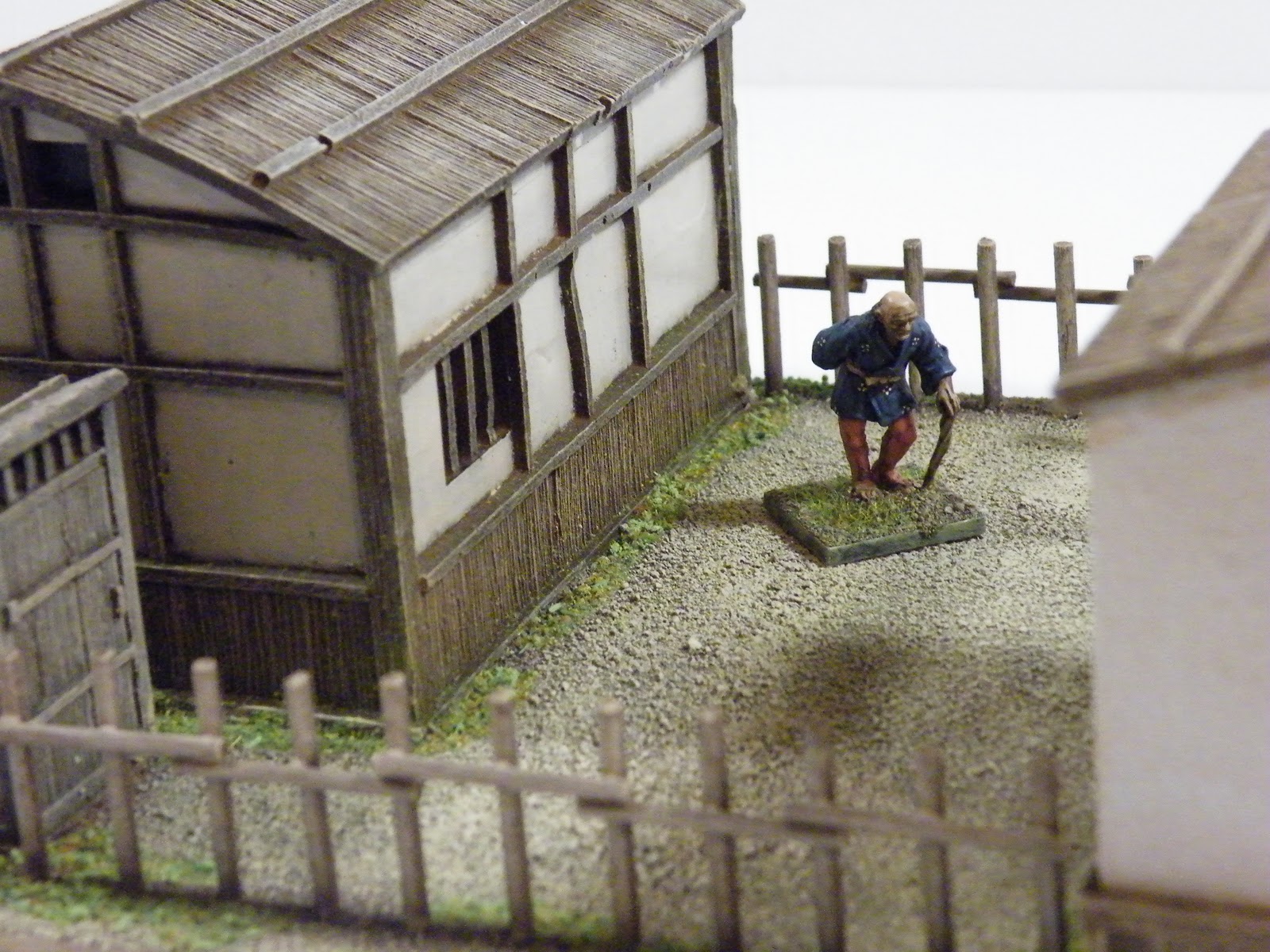
Most houses etc in small towns and villages (right up to the largest ones) would have a small garden or enclosure out the back. This would be used for perhaps a small garden, storage area (the unpainted building in the photo is a small kura or storehouse) or sometimes just a semi private place away from the bustle of the main street.


Construction was quite simple, a yadoya was taken from my stock and put in place at the front of the base, a fence was first sketched in place and then later permanently attached. it needed to be worked out first for the even placement of the uprights.

A small storehouse (or kura) was made next based on the same sort of design as the one in the catalogue but smaller and this was placed at the rear.A small well was built also and put towards the rear as this sees to have been the case more often than not. An outside toilet was also added to the side of the inn.

Once all the parts were in place the base was sanded as normal and then painted in the same way that all the Japanese terrain is done.

You can see the layout of the piece in the photo. The bases measures approximately 150mm x 250mm.

A couple of trees were added to give a bit more character and the well had a small rope with a weight attached. a few growies were added around the base to break up the ground colour.


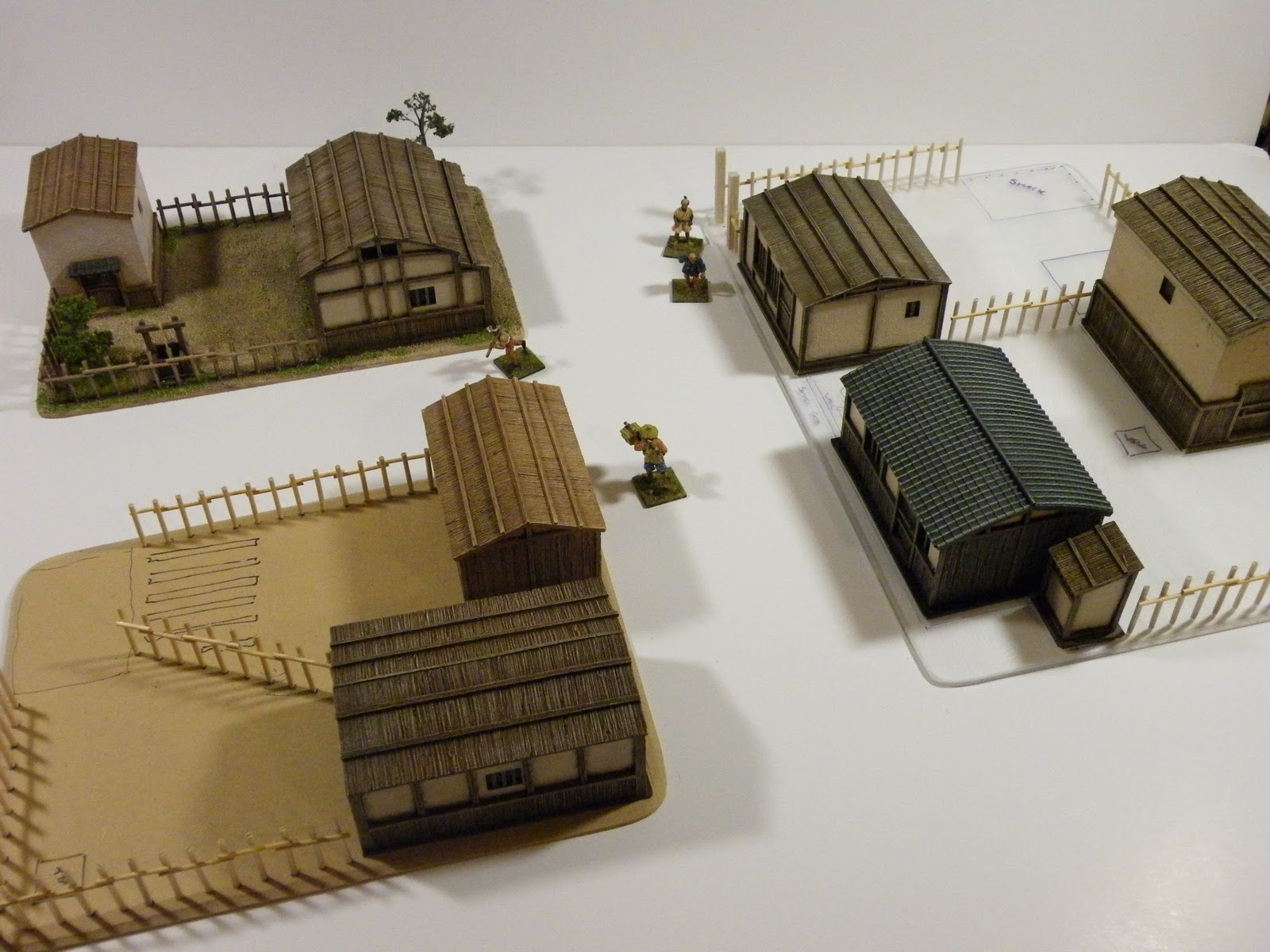
Doing this piece has added to an idea for my SALUTE board by utilizing the same idea for smaller, individual 'boards' that have one or two buildings on and can lead to greater variety in the future.

As you can see it is a very versatile set up with plenty of options, especially with more building bases. The one on the right is for Wayland Games as I am making their Bushido board for SALUTE (more posts on that soon). The one to the rear is Brians and the one at the front is mine for my SALUTE table.

For now I'll leave you with a few different shots of the original building base.


ttfn

11/12/2011

More samurai terrain

For today I've only got one thing to show, and it is a rural hillside graveyard which will be used for next years SALUTE board.

The basic shape was roughed out of yellow insulation foam and cork bark (where would we be without this!) which was placed randomly to look nice and to create a smaller profile that another hill wouldn't.

The base is 6mm MDF with a slight chamfer on it and everything was stuck together with a  hot glue gun (probably the best option for doing this sort of terrain.

The hill and ground were then sanded as per normal and then inked with watered down Windsor and Newton Peat ink.The rocks were also inked and one of the many good things about cork bark is the variety of colour that it has.

The graves were already stuck in place (but only undercoated) so a little care was needed in sanding around them but it didn't matter so much for the ink as it will add to the overall effect. (the black circle is a pen mark for the torii but I decided to leave it off).


The next stage was to drybrush the whole area and this was done with cheap artists acrylics and a rather large but soft brush. I generally go up in three colours of lightening tones for the drybrushing as it helps to bring the details and contours out, the rocks were drybrushed with varying greys and then some areas were washed over with a greeny/brown ink.

The groundwork was done as normal, using three different types of flocking, one was fine and is for normal open ground. Another is small grade sponge foam (differing colours) and the third is a special mix that I use for treed areas.

Trees can be added or removed quite easily as during the initial construction process I placed tubes at random intervals all over the hillside and kept them free or debris so the trees (which all have bare wire 'trunks') can be put in any order or type that I have from the box..

The graves were painted individually in different shades of warm greys and the names of who is buried there were written on with a fine line technical pen.

That's about it from me, I'll leave you with some more beauty shots :-)
ttfn